Rebuilding Relevance in Big Food
7 September 2026
Big food companies built their empires on scale, distribution muscle, and decades of brand recognition. But recognition is no longer…
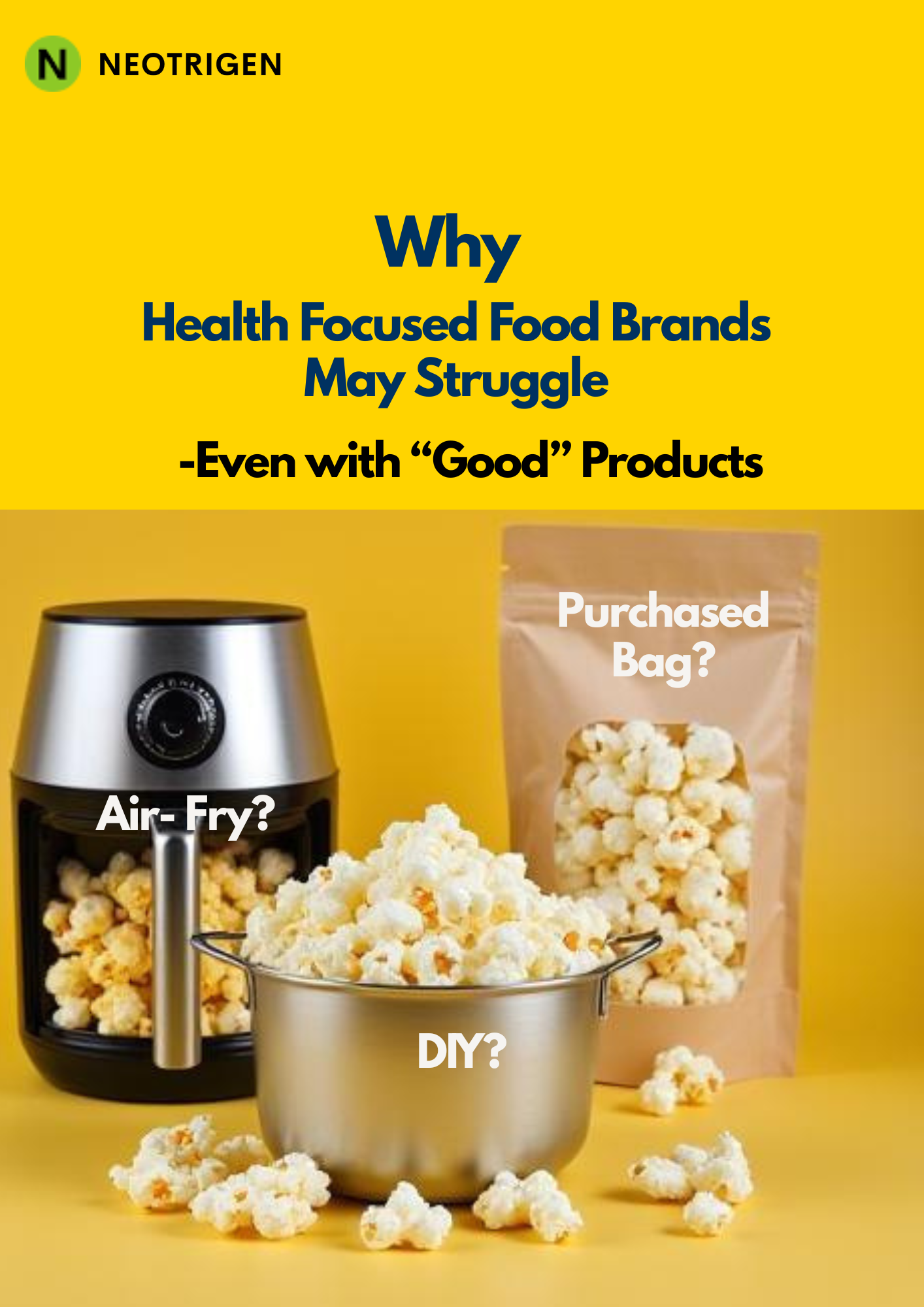
It’s one of the most frustrating patterns in the industry: a brand builds a genuinely healthy product clean ingredient list, real nutritional benefits, honest labeling and it still underperforms on the shelf. Meanwhile, a competitor with a far less impressive formulation outsells it two to one. For founders and innovation teams who’ve done everything “right,” this is baffling. But it’s also one of the most common findings in food consumer research product quality and market success are not the same thing, and the gap between them is where most health-focused brands lose. Understanding why requires food industry market analysis that goes beyond the lab and into the mind of the shopper.
Health-focused brands often assume that nutritional superiority sells itself. If a product has less sugar, more protein, or fewer additives than the competition, surely consumers will notice and choose accordingly. In practice, they rarely do at least not on nutrition facts alone.
Consumers don’t shop with a spreadsheet. They shop with associations, habits, and split-second emotional judgments. A product can be objectively “better” and still lose at the shelf because it fails to answer the question every shopper is unconsciously asking: does this fit into my life the way I already live it? This is where robust food consumer research becomes essential not to confirm that a product is healthy, but to understand whether that health benefit is being communicated in a way that actually changes behavior.
One of the most persistent barriers for health-focused products is what researchers call the “taste trust gap.” Consumers have been conditioned often through years of disappointing experiences to assume that healthier products taste worse. Even when a reformulated product tastes identical or better than a conventional one, shoppers frequently expect it to taste like compromise, and that expectation shapes the actual eating experience.
This is a textbook case for behavioural nudging in the food industry. Packaging cues, front-of-pack claims, and even the order in which benefits are listed can either reinforce or dismantle that expectation before a single bite is taken. Brands that skip this step and rely purely on nutritional messaging often unintentionally trigger the very skepticism they’re trying to overcome.
There’s a subtler trap many health-focused brands fall into: over-indexing on clinical, ingredient-heavy language. Terms like “low glycemic,” “functional protein,” or “clean-label formulation” may be accurate and even impressive to R&D teams, but to an everyday shopper, they can read as clinical rather than appetizing. Food is emotional before it is rational and language that sounds like a lab report rather than a craving rarely wins impulse purchases.
This doesn’t mean brands should hide their health credentials. It means the way those credentials are framed needs to be shaped by real shopper psychology, not internal product logic. A health nutrition consultant in Denmark, for example, understands how Nordic consumers who are simultaneously health-literate and skeptical of overclaiming respond very differently to subtle, credible health cues than to loud, superlative-heavy claims common in other markets.
A product doesn’t launch into a vacuum it launches into a category with existing habits, price anchors, and mental shortcuts already in place. A health-focused snack competing in an indulgence-driven category faces a completely different psychological battle than one launching in a category shoppers already associate with wellness.
This is where food industry market research proves its worth. Understanding category dynamics who’s buying, why, when, and what they’re mentally comparing your product against often reveals that a “good” product is being marketed in the wrong context entirely. A plant-based protein bar, for instance, might struggle in a traditional snack aisle but perform strongly when positioned and researched within the growing space of plant-based food research in Denmark, where consumers are already primed for that value proposition.
Sometimes the product isn’t the problem at all the shelf strategy is. Health-focused brands frequently launch with limited retail listings, inconsistent regional availability, or packaging that gets lost next to louder, more established competitors. No amount of product quality overcomes a shopper simply not seeing or not recognizing the product in the two seconds they spend scanning a shelf.
This is precisely why data driven food product strategy needs to extend past formulation and into go-to-market decisions: pricing architecture, shelf placement, pack format, and even seasonal timing. A nutritionally excellent product launched at the wrong price point, in the wrong pack size, or without visual differentiation will consistently underperform not because consumers rejected it, but because they never truly evaluated it.
The common thread across all of these struggles is the same: brands trust their own conviction about the product more than they test it against real consumer behavior. Founders and product teams are close to their formulation often too close to see it the way a first-time, distracted, price-conscious shopper does.
This is the core value of structured healthy product development insights to replace internal assumptions with evidence. Qualitative research uncovers the emotional and cultural associations shoppers bring to a category. Quantitative testing validates which claims, formats, and price points actually move purchase intent. Behavioral observation shows what people do at shelf, which is often very different from what they say in a survey. Together, these methods don’t just validate a “good” product they reshape how it’s positioned, priced, and communicated so its quality can actually be recognized and rewarded.
A genuinely healthy, well-formulated product is a necessary starting point but it’s not a strategy on its own. The brands that consistently succeed in competitive, health-conscious markets like Denmark are the ones that pair strong formulation with rigorous food market research in Denmark: understanding not just what consumers say they want, but how they actually behave when faced with real shelves, real prices, and real competing options.
Closing the gap between “good product” and “successful product” isn’t about compromising on health credentials. It’s about making sure every decision from claim wording to pack design to category placement is grounded in how real consumers think, feel, and choose. That’s the difference between a product that deserves to win and a product that actually does.
Neotrigen helps food and beverage brands turn strong formulations into market success through consumer insight, behavioural research, and data-driven product strategy across Denmark and beyond.