Consumer Personalities And Visual Cues In Food Choices- Shapes
22 February 2026
When consumers walk through a supermarket aisle or scroll through an online grocery platform, decisions happen faster than most brands…
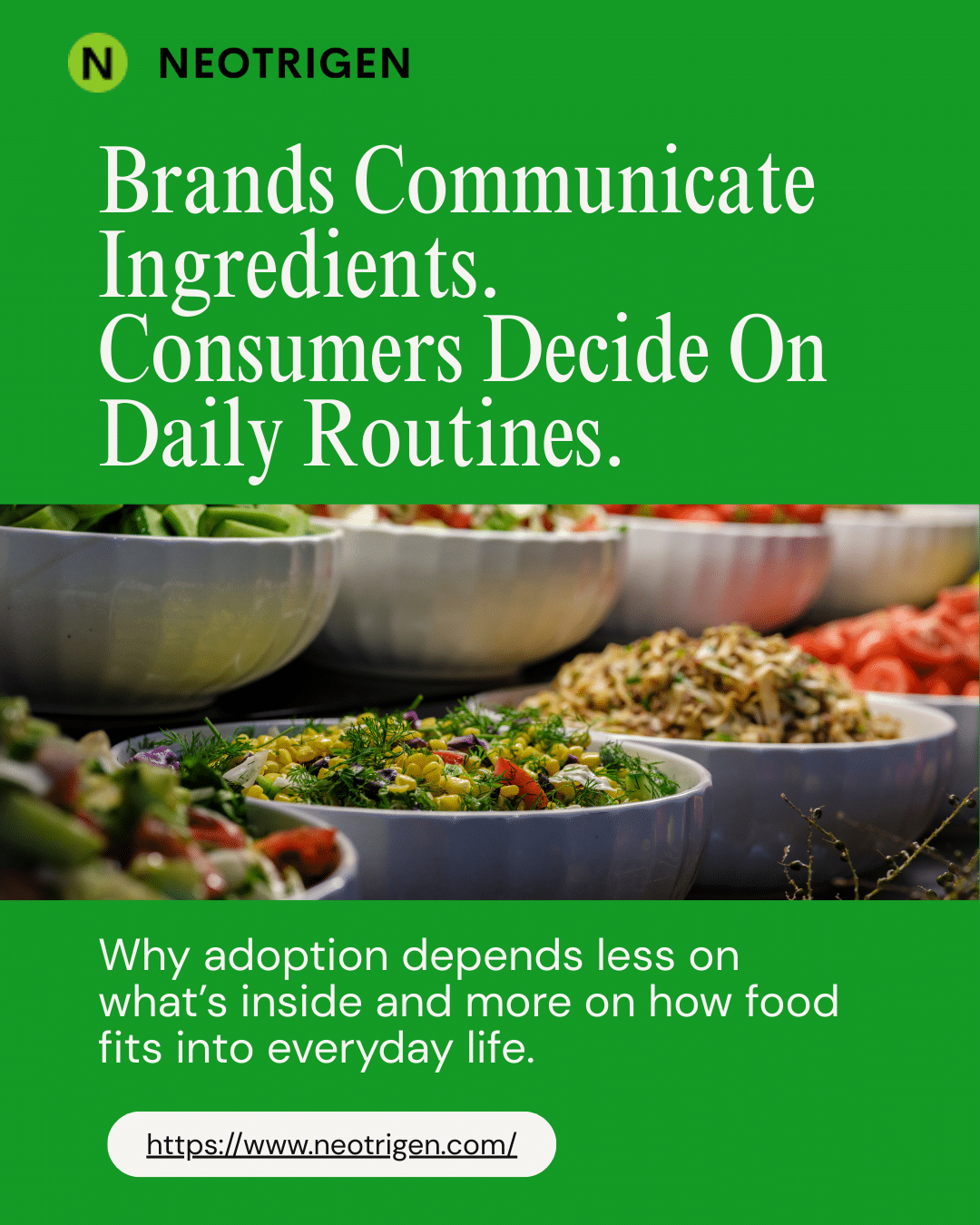
There is a gap that most food and beverage brands underestimate the distance between what a product says on its label and what a consumer actually does with it at 7 AM.
A brand might spend months perfecting a magnesium-enriched oat drink. The R&D team is proud of the formulation. The marketing deck celebrates the functional benefit. The packaging calls out “with magnesium” in bold. And then the product lands on a shelf and the consumer picks it up, checks the back, puts it down, and reaches for the one they bought last week. Not because they don’t care about magnesium. But because that oat drink doesn’t fit into who they believe they are on a Tuesday morning.
This is the insight that changes how you build products and how you talk about them.
When brands talk to consumers, they speak in ingredients: omega-3, adaptogens, plant protein, vitamin D3, live cultures, collagen peptides. These are real, meaningful things. But consumers don’t organize their lives around ingredients. They organize their lives around moments the morning coffee that signals the day has started, the protein shake that marks the end of a workout, the evening herbal tea that tells the body it’s time to wind down.
This is one of the most consistent findings in food consumer research: purchase decisions are rarely purely rational. Consumers are not scanning ingredient lists the way a nutritionist might. They are asking a faster, more instinctive question does this fit into my life?
Brands that understand this distinction are the ones that build lasting relevance. They don’t just communicate what is inside the product. They communicate where the product belongs in a consumer’s day.
From a food industry market analysis perspective, some of the most resilient brands in health and wellness are not winning on ingredient superiority alone. They are winning because they have successfully embedded themselves into a daily ritual.
Think about the oat milk category. The ingredient story is relatively simple. What differentiated the leaders was not a more advanced formulation it was a clearer identity around when and how the product is used. Morning. Coffee. Calm. That positioning created a routine anchor that competitors struggled to dislodge.
This matters enormously for healthy product development insights. When a product is designed or repositioned, the question cannot only be “what does this contain?” It must also be “what moment does this belong to, and what does the consumer believe about themselves in that moment?”
A data-driven food product strategy accounts for both. It looks at ingredient functionality and consumer behavior together not as separate workstreams, but as one integrated question about fit.
Consumers are not passive recipients of product information. They are active decision-makers operating under cognitive load, time pressure, and habit. This is where behavioral nudging in the food industry becomes a practical tool rather than an abstract theory.
Behavioral nudging is not about manipulating consumers. It is about designing the conditions under which the right choice becomes the easiest choice. Positioning a product within a morning occasion through imagery, timing of communication, even shelf placement and packaging cues reduces the decision effort for the consumer. When a brand aligns its communication with the moment a consumer is already primed to act, the ingredient story lands with far more impact.
This is particularly relevant for plant-based food research, where many brands have strong formulations but struggle to move beyond early adopters. The gap is rarely the product. It is often the routine narrative. Consumers who are not yet plant-based by identity need a gentler on-ramp one that fits plant-based choices into moments they already trust.
The value of food and beverage consumer insights is not in confirming what brands already believe about their products. It is in surfacing what consumers actually do which is often quite different from what they say they do, and even further from what brands assume.
Good consumer research in this space tends to reveal a few consistent patterns. Consumers who describe themselves as health-conscious are often not reading ingredient labels carefully they are reading signals. The font. The color. The tone of voice. The occasion the product seems designed for. These signals trigger a fast evaluation: is this for someone like me?
This is why food and beverage industry reports that focus only on purchase intent or category size miss the more actionable layer. The question is not whether consumers want functional food and drink they do. The question is whether a specific product fits naturally into the routines they have already built, or whether it asks them to build a new one. New routines are hard. Fitting into existing ones is a much shorter path to trial and repeat purchase.
For brands working with a food innovation consulting partner or a food and beverage consultant, this framing shifts the brief. It is not enough to ask: what ingredient should we lead with? The sharper question is: which consumer moment are we trying to own, and what does success look like in that moment?
This applies across categories from the beverage market to snacking to supplements to meal replacement. In each case, the brands that grow are the ones that earn a place in a routine, not just a position on a shelf.
The practical implication is that product development, marketing, and consumer research need to speak to each other much earlier in the process. Food consumer research should not arrive after the formula is locked. It should inform why the formula looks the way it does, and how the product will be talked about long before it reaches retail.
Consumers will believe in your ingredients once they believe in your product’s place in their life. The sequence matters. Lead with the moment. Let the ingredient be the proof point, not the headline.
Brands that internalize this think differently about everything from pack copy to campaign timing to how they brief innovation. They stop asking what should we put in it? and start asking when will someone reach for this, and why?
That question, answered well, is where real consumer connection begins.
Brands and Consumers by Sheena Christensen