Brands Communicate Ingredients. Consumers Decide On Perception
19 January 2025
Brands Communicate Ingredients. Consumers Decide On Perception Walk into any supermarket today and spend five minutes reading labels. You will…
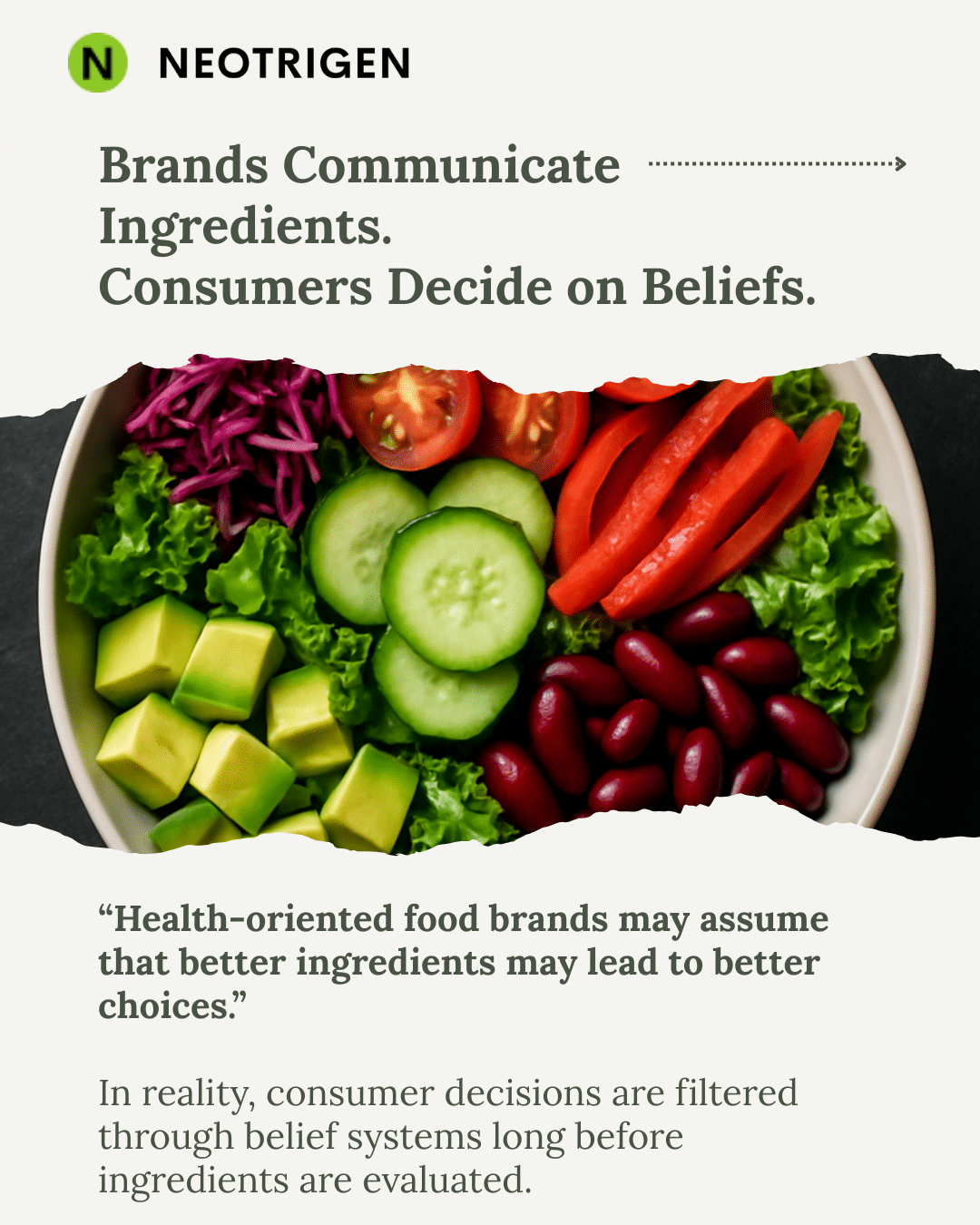
There is a persistent gap in how the food and beverage industry operates and it sits right between the label and the mind. Brands invest heavily in formulation. They work with scientists, source cleaner raw materials, and craft ingredient lists they believe will speak for themselves. But those lists do not speak. People interpret them. And interpretation is shaped by something far older and more stubborn than any marketing brief: belief.
Understanding that gap is not a branding exercise. It is a research challenge and one that a skilled food and beverage consumer insights agency is uniquely positioned to address.
When a product reaches the shelf, a brand controls quite a lot. The formulation. The packaging. The claim on the front panel. The placement in the store. The post on social media. These are levers that can be pulled, adjusted, and tested.
What brands do not control is the mental framework a consumer brings to the encounter. That framework has been built over years through personal experience, family habits, cultural norms, media exposure, and peer influence. It determines whether a consumer reads “sunflower oil” as a neutral ingredient or a red flag, whether “natural flavours” sounds reassuring or suspicious, and whether a health claim reads as credible or cynical.
This is not a consumer literacy problem. It is a consumer psychology reality. And it changes across geographies, demographics, and even life stages. The same ingredient list can generate trust in one segment and skepticism in another.
Brands tend to communicate what they believe is objectively good. Consumers evaluate what they subjectively trust. Those two things rarely align without deliberate effort.
A reformulation that removes an ingredient associated with harm say, a reduction in sodium may go completely unnoticed by the people it was designed to reassure. Not because they do not care about sodium. Because they have already formed a belief about the brand, the product category, or the type of processing involved, and that belief filters everything that comes after.
This is why clean label initiatives sometimes fail to move purchase behaviour. The ingredient change happened. The communication happened. But the underlying belief was never addressed.
Most market research tools are designed to measure what consumers say. Beliefs are rarely what consumers say they are what consumers do, feel, and assume without being asked.
A standard survey might ask: Do you read ingredient labels? The majority will say yes. A follow up question might ask: Do you understand the ingredients you read? Most will say yes again. Neither answer tells you whether the consumer trusts what they are reading, what associations they carry into that reading, or what would actually shift their interpretation.
Self reported data in food and beverage research suffers from a well documented problem: people answer with their aspirational selves, not their actual selves. They describe the careful, health conscious shopper they intend to be rather than the one who grabs a familiar product without reading a single word on the pack.
Belief level insight requires methodologies that go deeper that observe behaviour in natural contexts, that prompt discussion rather than questionnaire responses, and that allow the emotional texture of a consumer’s experience to surface. This is where video based qualitative research, diary studies, and co creation sessions prove their worth over and above a data table.
Consumer beliefs about ingredients form through a combination of pathways. Some are top down driven by media, health authorities, or prominent advocates. Some are social transmitted through communities, families, and peer networks. And some are deeply personal tied to a health scare, a life transition, or a moment of doubt that became a permanent filter.
For brands operating in the functional foods space, the plant based sector, or the increasingly scrutinized ultra processed category, this matters enormously. A consumer who has decided to believe that “anything with more than five ingredients is bad” will not be persuaded by a transparent label and a well intentioned claim. The belief precedes the communication. Only by understanding where the belief came from can a brand begin to think about how to engage with it honestly.
Denmark sits at an interesting intersection. Nordic food culture carries a strong tradition of quality, provenance, and sustainability values that have shaped consumer expectations in ways that ripple well beyond Scandinavia. A consumer insights company Denmark brings that cultural depth to research, while also operating with the methodological rigour that international food and beverage brands need when entering or growing within the European market.
NEOTRIGEN, based in Copenhagen, works specifically within this space. As a food and beverage consumer insights agency, the focus is on understanding the consumer as a whole person not just a data point through research methods that are designed to surface the unspoken, the assumed, and the emotionally loaded.
Belief level research is not abstract. It has a practical shape. It might involve live taste tests where participants articulate their reactions in real time, revealing the assumptions they bring before a product even reaches their mouth. It might involve video diaries that capture the grocery journey across a week, showing the quiet moments where a product is passed over for reasons the consumer themselves has never consciously examined.
It might involve virtual focus groups that move beyond consensus into genuine disagreement where one participant’s defence of an ingredient or process surfaces the anxiety another participant has been carrying silently.
Read More: Initial Steps For Knowing Your Consumer
The strength of a well designed qualitative research process is not that it replaces quantitative data. It is that it gives quantitative data somewhere meaningful to go. When you understand why a segment of your audience distrusts an ingredient, you can design a survey that actually tests the range of that distrust. You can develop a product narrative that speaks to the specific belief not just the ingredient and then measure whether it moves the needle.
This is the difference between consumer research that generates reports and consumer research that generates decisions.
The practical implication for brands is straightforward, even if the execution is not. Ingredient communication must be designed not just around the ingredient itself, but around the belief context in which it will be received.
That means knowing which ingredients carry baggage in your target segment. It means understanding whether your category has an underlying trust deficit or a trust surplus, and positioning your communication accordingly. It means recognizing that a consumer who already believes in what you stand for will read your label generously and a consumer who is skeptical will read it forensically.
Brands that invest in genuine consumer understanding not just consumer data tend to find that the product decisions, the communication decisions, and the innovation decisions become clearer. Not because the consumer tells you what to do, but because you stop assuming you already know why they do what they do.
The food and beverage market rewards brands that earn belief over time. That process begins with understanding what beliefs currently exist, where they come from, and how resilient they are in the face of new information. It is patient work. But it is the only kind that compounds.
If your brand is working through questions of consumer trust, ingredient perception, or market positioning in the food and beverage space, NEOTRIGEN offers research methodologies built specifically for this kind of challenge. As a food and beverage consumer insights agency operating out of Denmark, NEOTRIGEN brings both the cultural context and the research depth that complex consumer questions require. Whether you are entering a new market, repositioning an existing product, or trying to understand why a reformulation has not landed the way you expected the place to start is with the belief, not the label. Explore what NEOTRIGEN’s approach to consumer insights can surface for your brand at neotrigen.com.
Brands and Consumers by Sheena Christensen